
Introduction
In recent years, whether you’re shopping at a fast fashion mall, an outdoor sports store, or browsing the official websites of mid-to-high-end brands, you’ll almost always see terms like “eco-friendly fabrics,” “recycled materials,” and “green supply chain” appearing frequently.
You can notice:
Uniqlo, ZARA, and H&M launch eco-friendly clothing lines;
Outdoor brands such as Patagonia and The North Face were among the first to use recycled nylon and recycled polyester.
Many famous fashion brands such as Acgreen, Li-Ning, Banana, and BINGTECH are also actively investing in the development of environmentally friendly fabrics;
Even luxury brands like Stella McCartney and GUCCI are claiming to be “environmentally friendly and free of animal leather”.
Is this a fashion trend or an industry transformation? What problems do eco-friendly fabrics actually solve? And why have they become the focus of brands’ pursuit?
This article will give you a comprehensive understanding:
What are eco-friendly fabrics?
Why are brands collectively turning to it?
Its benefits, challenges and future potential
How should brands and consumers view this “green revolution”?
I. What is “eco-friendly fabric”? It is not simply “recycled fabric”
Eco-friendly fabric refers to textile materials that minimize environmental impact at every stage, including raw material sourcing, production process, usage cycle, and recycling . It typically includes, but is not limited to, the following types:
1, Recycled materials
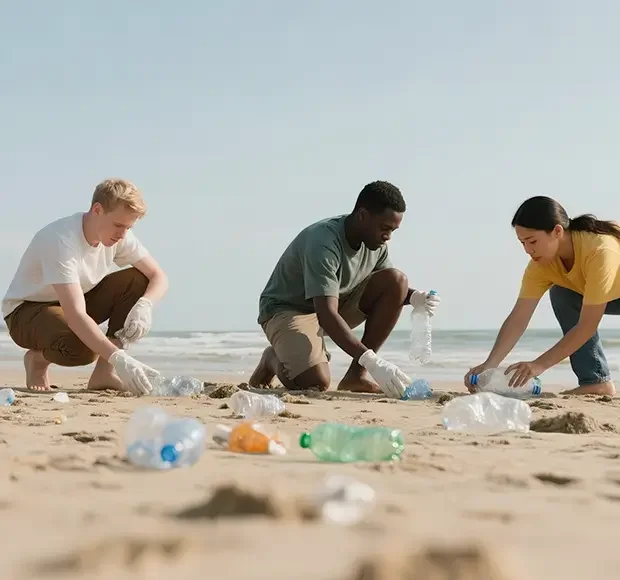
rPET (recycled polyester): Polyester fiber made from recycled plastic bottles.
Recycled Nylon (ECONYL®) : Nylon fibers extracted from discarded fishing nets and carpets.
Recycled cotton and recycled wool : recycled from old clothes or textile scraps
Recycled polyester + TPU composite : Suitable for functional sportswear and waterproof jackets
2, Natural and renewable products
Organic cotton
Flax, bamboo fiber, soybean protein fiber
Lyocell (Tencel) and other environmentally friendly solvent-extracted fibers
3, Bio-based/degradable materials
PLA fiber (polylactic acid) made from yogurt bottles
Seaweed fiber, orange peel fiber, coffee grounds fiber
Alternative leather materials such as mushroom leather
4, Materials manufactured using low-pollution processes
Plant staining, anhydrous staining
Laser printing, environmentally friendly flame retardant finishing
Solvent-free PU and fluorine-free three-proof film composite fabric
In summary, the essence of eco-friendly fabrics is not a single type of material, but a fabric system solution that integrates environmental protection concepts throughout the entire life cycle.
II. Why are brands increasingly emphasizing environmentally friendly fabrics?
There are six key driving forces:
1, ✅ Consumer attitudes are changing, with environmental protection becoming a purchasing motivation
Research shows that among Generation Z consumers:
More than 70% are willing to pay a higher price for “environmentally friendly products”;
Nearly 60% of buyers will abandon their purchase because the brand is “not environmentally friendly”;
Young consumers value “brand values” more than “price”.
In short: Environmental protection is transforming from a “bonus” to a “basic requirement”.
2, ✅ Policy pressure: those who don’t participate in environmental protection will be eliminated
The EU Carbon Border Adjustment Mechanism (CBAM) is about to be implemented, requiring exporting companies to provide a “carbon footprint” certificate.
The EU Ecodesign directive requires textiles to be traceable and recyclable.
California’s Sustainable Textiles Act requires brands to disclose their environmentally friendly supply chains.
Under China’s “dual carbon targets,” factories must conserve energy and reduce emissions, with fabrics being a key area for source control.
Environmental protection is no longer a “choice” for brands, but a “must-answer” question for policy.
3, ✅ Fast fashion transformation: Is environmental protection a “whitewash” or a “breakthrough”?
Fast fashion faces challenges such as high inventory levels, environmental concerns, and a lack of supply chain transparency. Switching to environmentally friendly fabrics can:
Criticism mitigation (Greenwashing or not)
Develop a “slow fashion” sub-brand
Create marketing highlights such as “environmentally friendly co-branding” and “limited edition series”.
For example, H&M launched the “Conscious series”, ZARA established Join Life, and SHEIN is also working on environmental factory certification.
4, ✅ ESG Capital Value: Eco-friendly Fabrics Help Brands Go Public and Increase Valuation
The capital market favors companies with excellent ESG performance. Environmentally friendly fabrics can:
Increase the brand’s score in sustainability ratings;
To ensure that listed companies include “green selling points” in their prospectuses;
Obtain support from green loans, environmental subsidies, and tax reduction policies.
5, ✅ The technology is mature, and environmentally friendly materials are no longer “low-end substitutes”
Today’s environmentally friendly fabrics have overcome the problems of being “rough, not durable, and lacking in functionality” in the past, and now possess the following advantages:
Features include antibacterial and deodorizing properties, waterproof and breathable properties, and quick-drying properties.
Diverse styles: matte, glossy, twill, plain, composite, windproof, three-layer lamination;
High stability, water-resistant, and available in a variety of colors.
Brands no longer need to choose between “environmentally friendly” and “aesthetically pleasing”.
6, ✅ In a highly competitive market, environmental protection is a differentiating factor
Environmental protection is an emotional value that a brand can tell and communicate. A hangtag reads:
“This garment is made from 8 recycled bottles,” “This fabric is biodegradable,” and “The raw materials come from organic cotton fields, are pesticide-free, and GMO-free” are more appealing than “cheap” or “slim fit.”
III. What are some representative brand practice cases for environmentally friendly fabrics?
☑️ 1. Patagonia: Environmental Pioneer
Over 70% of all clothing is made from recycled materials;
Use recycled fishing nets to make jackets and coffee grounds to make thermal underwear;
Declaring “Earth is the sole shareholder,” creating a textbook example of environmental protection brands.
☑️ 2. UNIQLO: Rational Transformation
Dry-EX and BLOCKTECH series use recycled polyester;
The plan is to have 60% of all fabrics sourced sustainably by 2030.
Emphasis should be placed on both functionality and environmental protection.
☑️ 3. Stella McCartney: High-end eco-friendly fashion
Mushroom skin and grape skin were used as substitutes for leather;
Never use animal fur;
It has become an important testing ground for LVMH’s environmental strategy.
☑️ 4. BINGTECH: A representative of domestically produced environmentally friendly functional fabrics
Focusing on three-layer composite functional fabrics, covering skiwear, sun protection clothing, etc.;
Uses GRS-certified rPET, fluorine-free film, and highly washable environmentally friendly adhesive;
We serve mid-to-high-end sports brands and OEM factories.
IV. Challenges and Difficulties of Using Eco-friendly Fabrics: Not All Brands Can Easily Implement This Approach
Although the prospects are bright, making “eco-friendly fabrics” is not easy:
| Difficulty | Illustration |
|---|---|
| Unstable raw material recovery | Recycled bottles, old clothes, etc. come from diverse sources and vary in quality. |
| High cost | Organic cotton and recycled film are 10-30% more expensive than traditional raw materials. |
| Complex process | Higher requirements for composite materials, functional integration, and color matching. |
| Certification costs are high | Certifications such as GRS, OEKO-TEX, and BLUESIGN require time, manpower, and money. |
| Consumers have limited understanding | End users’ understanding of “environmentally friendly” often stops at “whether it’s pure cotton”. |
| Green reshuffling is common. | The market is flooded with hype surrounding “pseudo-environmental” concepts, which can easily lead to consumer fatigue. |
Therefore, eco-friendly fabrics are a long-term, systematic project that requires brand strategy, R&D capabilities, and value resonance; it’s not something that can be solved once and for all by simply changing the material.
V. Future Trends in Eco-friendly Fabrics: From “Materials” to “Ecosystems”
🌱 1. Lifecycle management (LCA) will become standard
Not only should the raw materials be environmentally friendly, but we should also pay attention to:
Dyeing and finishing wastewater treatment
Carbon emissions from manufacturing process
Product lifespan and recyclability
Closed loop of recycling
🌐 2. Digital Traceability System: QR codes tell you where the fabric came from
Blockchain traceability, carbon labeling, and ESG disclosure systems will become new forms of brand credibility.
🔁 3. Deep integration of functional and environmentally friendly materials
The future is not about “environmental protection vs. functionality,” but rather “environmental protection + technology + experience.”
Recycled fabric + antibacterial, wrinkle-resistant, and cooling
Biodegradable material + quick-drying, breathable, and sun-protective
Decarbonization process + three-proof, oil-proof, and stain-resistant
📦 4. Eco-friendly fabrics × Brand story × User emotions
Environmental protection is not just an attribute, but also the core of brand story communication:
This garment was woven from old fishing nets.
These pants came from factory scraps.
“We use one mushroom cap instead of one animal skin.”
Emotional value combined with environmental narratives will become the key to creating viral content.
VI. How should brands systematically enter the environmentally friendly fabric market?
- Define your positioning: Do you want to “promote environmental protection” or “truly transform”?
- Establish a cooperative chain: Find professional environmentally friendly fabric factories to cooperate with, such as source fabric factories with GRS and OEKO-TEX certifications.
- Controlling cost structure: Balance costs by placing orders on a large scale and selecting environmentally friendly fabrics with medium-level functions.
- Design drives narrative: Environmental protection ≠ simplicity; use fashionable design to package the “green” concept.
- Marketing transparency: Let consumers know what you use, why you use it, and what it means for the planet.
- Educate consumers over the long term : Environmental protection is not a short-term trend, but a way to co-create value.
In conclusion: Eco-friendly fabrics are not just a passing fad, but an inevitable trend
Eco-friendly fabrics are not just a trend, but a “green industrial revolution” that the global fashion industry is undergoing . From raw materials to design, from consumers to capital, from niche trials to policy guidance, it has become an irreversible direction for the entire industry.
The competition among brands in the future will not only be about price and style, but also about “concepts”, “responsibility” and “material systems”.
Choosing eco-friendly fabrics means choosing to stand on the side of the future.